Business waste management carries significant legal responsibilities, and many organisations do not yet realise how much is about to change. With the UK preparing to introduce a Digital Waste Tracking system, the way businesses record, track, and report waste movements is set to become far more transparent and data-driven.
For many years, businesses have maintained this structure by utilising paper waste transfer notes. However, paper records are easily lost, frequently damaged, and notoriously difficult to audit.
To address this, the government is modernising environmental data through a mandatory digital waste-tracking system.
What is digital waste tracking? The system is a central government-owned and operated waste database for the digital recording of the movement of commercial waste throughout the United Kingdom. In the absence of paper, the system provides a clear, unbroken chain of responsibility for the waste produced, handled, and processed.
If you are a business owner or facilities manager wondering how digital waste tracking works, how it impacts your daily operations, and what you need to do to stay compliant, this comprehensive guide explains everything you need to know.
What Is Digital Waste Tracking and Why Is It Changing?
To understand the shift towards digital waste tracking in the UK, we must first look at the limitations of the current system. Every year, UK businesses produce millions of tonnes of commercial waste. Currently, the movement of this waste is recorded on over 20 million paper waste transfer notes annually.
For a business, this means physical paperwork must be signed, filed, and securely stored for at least two years to satisfy your legal Duty of Care.
If the Environment Agency requests an audit, tracking down historical paper notes from a busy site office or a dusty filing cabinet can be incredibly stressful and time-consuming.
This new digital system moves the entire operation to the cloud. Rather than a customer signing a clipboard on a loading bay, the loading process of waste is digitally documented. In a live, government-run database, the lifecycle of all loads of waste is available, transparent, and legally accountable.
Why Is the UK Introducing Digital Waste Tracking?
The Department for Environment, Food and Rural Affairs (Defra), alongside the Environment Agency, have championed this transition. The move to a digital system is not simply an administrative upgrade; it is a critical regulatory overhaul driven by three major factors.
1. Tackling Waste Crime and Fly-Tipping
Waste crime is a severe issue in the UK, costing the economy an estimated £1 billion every year. Illegal fly-tipping, unauthorised waste sites, and the illegal export of hazardous materials are persistent problems. Paper records make it notoriously difficult for regulators to trace exactly where waste ends up once it leaves a business premises.
With a digital system, there is an embedded closed loop. If a licensed carrier takes waste but it doesn’t reach a licensed disposal site, the digital system alerts you immediately. It is difficult for any unauthorised and dodgy operator to fly-tip anywhere.
2. Simplifying Digital Waste Tracking Compliance
Maintaining physical records is an administrative burden for businesses of all sizes. Under the Environmental Protection Act 1990, every commercial entity has a Duty of Care to ensure their waste is handled legally. Proving this requires meticulous record-keeping.
Digitising this process removes the risk of human error. It eliminates the need for physical storage space and ensures that if you are ever audited, your compliance data is instantly accessible. Digital waste tracking compliance is fundamentally about making it easier for honest businesses to prove they are doing the right thing.
3. Driving the Circular Economy and Sustainability
To improve national recycling rates and invest in the right waste treatment infrastructure, the UK government needs accurate data. Currently, because data is trapped on millions of scattered paper notes, the government lacks a real-time understanding of what types of waste are being produced and where.
Digital tracking provides immediate, macro-level insights. By understanding exactly how much plastic, food waste, or electronic waste is moving through the system, regulators can build better recycling infrastructure. For businesses, this accurate data also makes corporate Environmental, Social, and Governance (ESG) reporting far more precise.
Digital Waste Transfer Note: Explained
“What about my typical waste records?”
This is one of the most common questions businesses ask. Let’s clearly establish –
A traditional waste transfer note is a legal document that explains a transfer of non-hazardous waste from one party to another, describing the type of waste being transferred, its weight, the European Waste Catalogue (EWC) code and is acknowledged by the producer and licensed carrier.
A digital waste transfer note captures the same information electronically.
The Operational Benefits of Digital Notes:
• Zero physical storage: You no longer need to dedicate office space to archiving two years’ worth of paperwork.
• Instant retrieval: If you need to review your waste output for a specific month, you can filter and search your digital records instantly.
• Improved accuracy: Digital systems often use dropdown menus for EWC codes and automated weight logging, vastly reducing the spelling mistakes and illegible handwriting that plague paper notes.
• Seamless hazardous waste tracking: For hazardous waste disposal in London, the paper consignment note will also be replaced by a digital equivalent, ensuring highly restricted materials are tracked with absolute precision.
How Does a Digital Waste Tracking System Work?
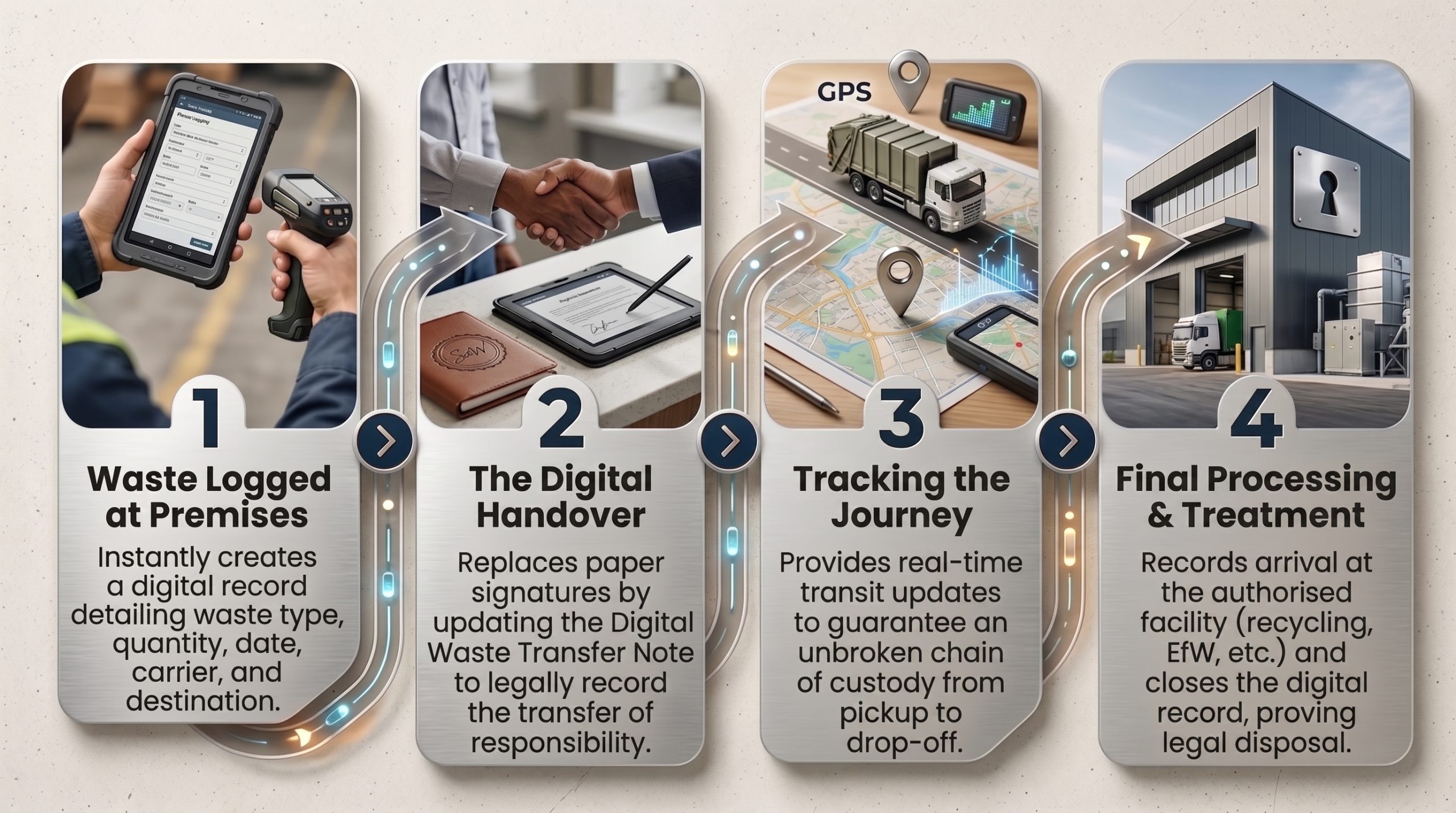
While the underlying technology is complex, the operational reality for businesses is highly streamlined. How digital waste tracking works can be broken down into a simple, four-step lifecycle.
Step 1: The Waste is Logged at Your Premises
When waste is collected from your business, a digital record is created to track that movement. This includes the type of waste, quantity, collection date, licensed waste carrier, and the destination facility where the waste will be processed.
Step 2: The Digital Handover
When your licensed waste carrier (such as Enviro Waste Management) arrives at your premises, the legal transfer of the waste is recorded on the digital system. Instead of signing a physical piece of paper, the digital waste transfer note is updated to show that responsibility has safely passed to the authorised carrier.
Step 3: Tracking the Journey
While the waste is being transferred, the digital record continues to update in real time. The system notes who is taking the waste and where it is going; an unbroken chain of custody.
Step 4: Final Processing and Treatment
After reaching its destination – be it a sorting facility, recycling centre or an EfW plant – a record is made of its arrival. The digital record is then closed off, proving beyond doubt that the waste reached its end market via a legal and accountable route.
For business owners, this creates full visibility over where waste goes after collection, helping confirm it has been handled through authorised facilities and reducing the risk of illegal disposal or fly-tipping.
Which Businesses Will Be Affected?
The short answer is universal: if your business produces any form of commercial waste, digital waste tracking will affect you.
There are no exemptions based on your company’s size. Whether you are an independent high-street café or a multi-site industrial manufacturer, you will need to adopt digital waste tracking. However, the operational impact will look slightly different depending on your sector:
1. Offices and Corporate Facilities
In a typical office setting, this transition will have a great advantage. Facilities Managers responsible for General Waste, Mixed Recycling, and WEEE disposal will no longer need to run around departments chasing up paper receipts. All collections will appear on a single digital dashboard, making monthly sustainability reporting simple.
2. Construction and Demolition
The construction industry generates significant quantities of bulk, awkward or potentially dangerous waste. Site managers frequently struggle to manage the mountains of paperwork needed to justify and evidence the disposal of asbestos, chemicals, or bulk hardcore. Using mobile devices for site managers to log waste movements at the point of collection means that live building sites will always be compliant, and business will continue uninterrupted.
3. Retail and Hospitality
As these venues-pubs, restaurants, and shops need regular pick-ups, due to food waste and packaging disposal, the daily requirement to sign a paper note is an unnecessary burden for shift managers. Electronic data logging will eliminate much of this daily repetition.
4. Healthcare and Industrial Facilities
Clinically oriented waste sectors, chemical companies, and industries handling heavily regulated materials will benefit from greater security provided by the new system. The digital chain of custody means that regulated or hazardous materials are tightly controlled from the lab or clinic all the way to the specialist thermal treatment centre.
Digital Waste Tracking Timeline UK
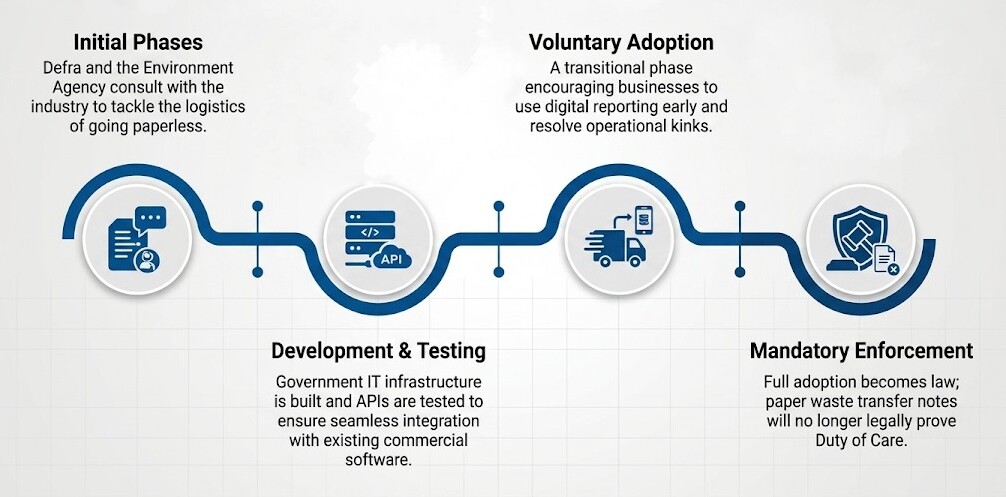
The government’s rollout of the digital waste tracking system is a phased, multi-year project. Because building a database capable of handling tens of millions of records annually is complex, the UK’s digital waste-tracking timeline has been structured to allow businesses and waste carriers time to prepare.
• Initial Phases: Defra and the Environment Agency spent several years consulting with the waste industry to understand the logistical challenges of replacing paper.
• Development and Testing: The government has been building the IT infrastructure, allowing select waste management companies to test the Application Programming Interface (API) to ensure it integrates with existing commercial software.
• Voluntary Adoption: Before the system becomes a strict legal requirement, there is a transitional period where businesses and carriers are encouraged to begin using digital reporting voluntarily to iron out any operational wrinkles.
• Mandatory Enforcement: The ultimate goal is full mandatory adoption, at which point paper waste transfer notes will no longer be legally recognised as proof of your Duty of Care.
While the exact dates for mandatory enforcement are subject to government confirmation, the clearest advice for businesses is not to wait for the final deadline. Transitioning your processes early ensures you are not caught off guard by sudden regulatory enforcement.
Preparing for Digital Waste Tracking: Actionable Steps
You do not need to implement an invasive solution for digital waste tracking. A few simple proactive steps can facilitate an easy transition.
1. Conduct a Comprehensive Waste Audit
You cannot accurately track what you do not understand. Now is the perfect time to review exactly what waste your business produces with a comprehensive waste audit and consultancy. Identify your different waste streams (general, dry mixed recycling, food waste, confidential documents). Understanding your outputs will make the digital logging process much smoother.
2. Review Your Current Provider
Are you currently using multiple different “man with a van” services, or relying on outdated providers who still operate heavily on paper? If your current waste carrier is not preparing for digital integration, your business will struggle to remain compliant. Ensure you are working with an authorised, forward-thinking waste management company.
3. Consolidate Your Waste Services
A single supplier for all your waste streams makes digital compliance very straightforward. Instead of dealing with one firm for WEEE disposal and a different one for general waste, consolidating all your waste services with one convenient digital dashboard makes management a breeze.
4. Educate Your Staff
Make sure that your facilities team, site managers and administrative staff know that the paper-based waste transfer notes are being replaced. Talk to them about the need to be digitally compliant to avoid any confusion internally.
How Enviro Waste Management Simplifies the Transition
At Enviro Waste Management, we believe that regulatory changes should never create operational stress for our clients. We are a compliance-first waste management partner, meaning we have been actively preparing for the future of digital tracking, so you do not have to worry about it.
Our focus is on making your commercial waste disposal simple, reliable, and completely legally secure.
Here is how we support your business:
• In-House Fleet and Control: Unlike brokers who outsource your waste to third parties, we operate our own in-house fleet of drivers. This gives us complete control over your collections and ensures your digital chain of custody is never compromised by unknown subcontractors.
• Automated Communication: We already embrace digital efficiency. When you book a collection, you receive automated email alerts confirming your schedule and real-time ETA updates on the day of service, so you never have to guess when we will arrive.
• Full Waste Reporting: Let us do all the legwork with the paper trail. We manage everything from legacy paper transfer notes through to the new digital system, so the administrative burden never falls on you.
• Unmatched Sustainability: We don’t just track your waste; we process it responsibly. Utilising our own sorting facilities, we ensure that salvageable items are repurposed and that 99.88% of the waste collected is diverted from landfills, supporting the circular economy.
By partnering with Enviro Waste Management, you are choosing a team of dedicated professionals who turn complex compliance requirements into a seamless, invisible part of your daily operations.
Contact us today to discuss your collection requirements with our specialists.
Frequently Asked Questions (FAQs)
The best approach is simply to ask them. A reputable, licensed waste carrier will be fully aware of the upcoming Defra regulations and will already have a roadmap in place for integrating their reporting software with the government’s digital system. If your current provider is unaware of digital waste tracking, it is strongly advised to switch to a compliance-focused professional service.
Absolutely. One of the greatest benefits of the digital system for businesses is data accuracy. Because the system provides highly precise, real-time data on exactly how much waste you produce and whether it was recycled, recovered, or sent to a landfill, businesses can use this validated data to strengthen their corporate Environmental, Social, and Governance (ESG) reports.
Currently, under paper-based rules, businesses must retain general waste transfer notes for a minimum of two years, and hazardous waste consignment notes for three years. The distinct advantage of the digital system is that it automatically stores and securely archives these records in the cloud, meeting your retention requirements without the need for physical filing cabinets.
Failing to maintain accurate waste records is a direct breach of your business’s environmental Duty of Care. Non-compliance can result in severe financial penalties, fixed penalty notices, and, if the lack of documentation is linked to illegal waste dumping (fly-tipping), formal prosecution by the Environment Agency.
Yes. Once the government transitions from the voluntary testing phase to full implementation, digital waste tracking will become a legal requirement for any UK business that produces, handles, transports, or disposes of commercial waste, regardless of the organisation’s size.
Yes. The definitive goal of the UK government’s digital waste tracking initiative is to completely phase out all physical, paper-based waste transfer notes and hazardous waste consignment notes. Eventually, only digital records logged on the central database will be legally recognised for compliance purposes.