
Managing commercial waste in a busy workplace often feels like a logistical balancing act. Between keeping the office clean, remaining legally compliant, and trying to hit corporate sustainability goals, waste disposal can easily become an administrative headache.
One of the biggest challenges businesses face is finding the space – and the staff compliance – to separate every single type of recyclable material into different bins.
This is where a dry mixed recycling collection transforms workplace waste management.
If you are looking for a straightforward way to boost your business’s recycling rates without dedicating half of your premises to different bins, you have likely come across the term “DMR”.
But exactly what is dry mixed recycling, what items are actually allowed in the bin, and how does the process work behind the scenes?
In this comprehensive guide, we will explain everything UK businesses need to know about dry mixed recycling waste, how to prevent contamination, and how consolidating your recyclables can streamline your daily operations.
What Is Dry Mixed Recycling (DMR)?
Dry mixed recycling (DMR) is an innovative commercial waste solution that allows businesses to dispose of multiple types of clean, uncontaminated recyclable materials into a single, shared bin.
Instead of requiring your staff to meticulously sort paper into one container, plastic bottles into a second, and metal drinks cans into a third, a dry mixed recycling bin accepts all of these materials together. Once the bin is collected by a licensed commercial waste carrier, the combined waste is transported to a specialist Materials Recovery Facility (MRF). At this facility, advanced sorting technology – including optical scanners, magnets, and eddy current separators – separates mixed recyclable materials and individual waste streams so they can be processed and repurposed.
Key Takeaway:
Dry mixed recycling allows businesses to place uncontaminated paper, cardboard, plastics, and metal packaging into a single recycling container, simplifying waste management while improving recycling rates and supporting regulatory compliance.
Defining “Dry” vs “Mixed” Operational Parameters
To fully understand dry mixed recycling in the UK, it helps to break the terminology down:
• Dry: This is the most critical rule of the system. Every single item placed in the bin must be completely free from food residue, liquids, grease, and moisture.
• Mixed: It combines standard, everyday recyclables (such as paper, cardboard, plastics, and metals) into a single convenient container.
For facilities managers and business owners, implementing a dry mixed recycling bin is one of the easiest ways to improve environmental responsibility. It removes the friction in workplace recycling, meaning staff are far more likely to dispose of items correctly rather than simply throwing everything into the general waste for convenience.
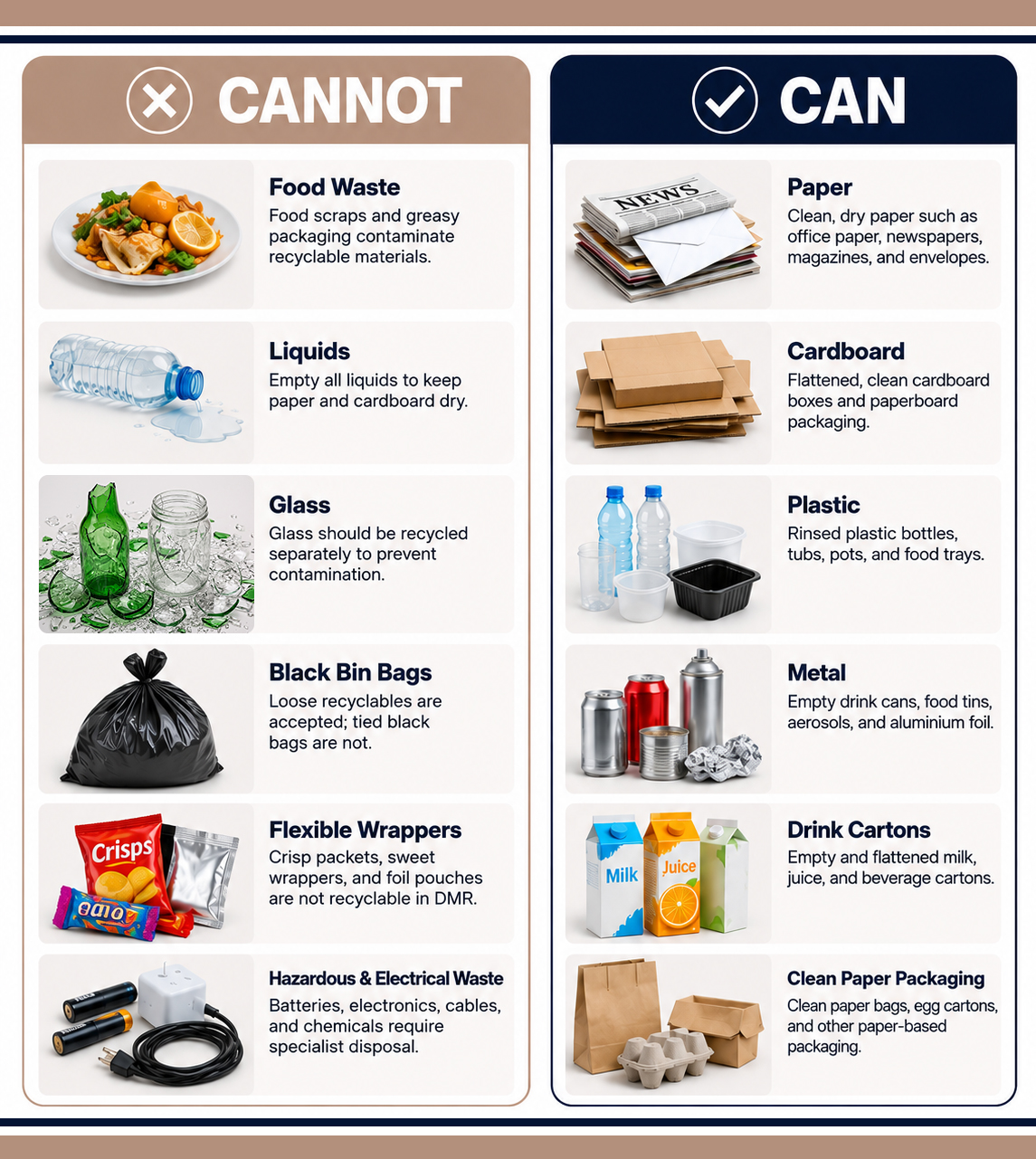
What Can Go in a Dry Mixed Recycling Bin?
The success of any commercial recycling service relies on placing the right items in the right containers. While a DMR bin is highly versatile, it is specifically designed for clean, everyday packaging and office materials.
If you are setting up business recycling solutions for an office, retail store, or hospitality venue, here is a detailed breakdown of the exact mixed recyclable materials that can safely go into your dry mixed recycling bin.
1. Paper
Paper is one of the most common waste streams produced by UK businesses, particularly in corporate offices, educational facilities, and administrative departments. Fortunately, almost all clean paper can be placed in your DMR bin.
• Accepted items: Office printer paper, newspapers, magazines, brochures, leaflets, non-confidential letters, envelopes (even those with small plastic windows), and soft-backed catalogues.
• Operational Tip: Ensure the paper is dry. If a half-empty cup of coffee spills onto a stack of printer paper inside the bin that paper becomes contaminated and can no longer be recycled. (Note: Highly sensitive employee or client data should never go into standard recycling; it requires a secure, confidential waste disposal service.)
2. Cardboard
Cardboard is very readily recyclable and forms a key part of dry mixed recycling collections, particularly for retail sites and offices.
• Accepted items: Corrugated cardboard boxes, cereal boxes, clean ready-meal sleeves, greeting cards (without glitter or foil), and toilet roll tubes.
• Operational Tip: Always ask your staff to break down and flatten cardboard boxes before putting them in the bin. Unflattened boxes take up a massive amount of unnecessary volume, meaning your bins fill up faster and you end up paying for collections of empty air.
3. Plastics
Plastic packaging is commonly found in the workplace due to staff lunch and break areas. PET (Type 1) and HDPE (Type 2) are universally accepted in DMR, whereas types like polystyrene (Type 6) are rejected
• Accepted items: Plastic drinks bottles (water, soft drinks), milk cartons, clean plastic food trays, yoghurt pots, and plastic tubs (such as margarine or ice cream containers).
• Operational Tip: The “dry” rule is vital here. A yoghurt pot must be rinsed clean before it goes into the bin. If a plastic food tray is still covered in sauce, it will contaminate the surrounding dry waste.
4. Metals
Metals are incredibly valuable in the circular economy because materials like aluminium can be recycled infinitely without losing their quality. Recycling aluminium saves up to 95% of the energy required to produce new aluminium from raw materials, making it one of the most valuable materials recovered through dry mixed recycling streams.
• Accepted items: Aluminium drinks cans (fizzy drinks, energy drinks), clean steel food tins (soup or bean tins from the staff kitchen), empty aerosol cans (such as air fresheners, provided they are completely empty), and clean aluminium foil.
• Operational Tip: Just like plastics, food tins must be rinsed clean. Staff should also be encouraged to crush aluminium cans where possible to save bin space.
What Cannot Go in a DMR Bin?
Understanding what cannot go into a dry mixed recycling bin is arguably more important than knowing what can. When the wrong items are thrown into a DMR container, it causes contamination.
Contamination is the biggest threat to commercial recycling. If a bin is heavily contaminated with non-recyclable materials, the sorting facility may reject the entire load, forcing it to be redirected to general waste or an Energy from Waste (EfW) facility. To maintain a pristine dry mixed recycling waste stream, ensure the following items are strictly kept out.
1. Food Waste
Food is the number one enemy of dry mixed recycling. Even a small amount of food waste—such as a half-eaten sandwich, a greasy pizza box, or a dollop of sauce—can ruin an entire bin of clean paper and cardboard. Food residue causes paper fibres to break down and introduces mould and bacteria to the sorting process. Food waste must always be placed in a dedicated food waste bin or a general waste bin.
2. Liquids
Liquids will ruin paper and cardboard recyclables. If a worker places their partially full juice bottle in the DMR bin and the bottle leaks, the paper will turn to mush. Since the MRF cannot sort out soggy paper in its machinery, the paper will become a contaminant and will be pulled from the streams. Please dispose of liquids in the sink.
3. Glass
While glass is highly recyclable, it should almost never be placed in a standard dry mixed recycling bin. When heavy bins are tipped into collection trucks, glass bottles shatter. The tiny shards of broken glass become deeply embedded in the paper, cardboard, and plastic within the load. Because it is nearly impossible for machinery to safely separate shattered glass from paper fibres, glass must be collected in a separate, dedicated glass recycling bin.
4. Black Bin Bags
You should never put your clean recyclables inside a tied black bin bag before throwing them in the DMR bin. Sorting facilities operate at high speeds, and machinery cannot see inside tied black sacks. For health and safety reasons, workers cannot manually rip open black bags to check if the contents are recyclable. Therefore, tied black bags are instantly pulled off the line and treated as general waste. Recyclables should be placed in the bin loose or in clear recycling sacks.
5. Crisp Packets and Sweet Wrappers
These are known as composite materials (often a mix of plastic and metallic foil). Standard DMR sorting facilities cannot separate these materials, so they must be placed in the general waste bin.
6. WEEE and Hazardous Waste
Waste Electrical and Electronic Equipment (WEEE)—such as old keyboards, cables, vapes, or batteries—must never go into a DMR bin. Batteries, in particular, are highly dangerous; if they are crushed in the back of a collection truck or sorting facility, they can easily spark and cause devastating fires. Similarly, hazardous materials such as paint tins, chemicals, and clinical waste require specialist compliance handling.
Dry Mixed Recycling and UK Compliance
For UK businesses, dry mixed recycling is not simply a sustainability initiative – it also plays an important role in regulatory compliance.
Recent changes to workplace recycling requirements mean businesses must take greater responsibility for how recyclable materials are managed and separated.
Simpler Recycling Requirements
The UK Government’s Simpler Recycling reforms aim to create a more consistent recycling system across England by standardising the materials that households and businesses are expected to separate for collection.
Under these reforms, businesses are increasingly encouraged to ensure recyclable materials are diverted from general waste wherever possible. Implementing a dry mixed recycling collection can help organisations simplify compliance while improving recycling performance.
Duty of Care Obligations
Under Section 34 of the Environmental Protection Act 1990, every business has a legal Duty of Care regarding the waste it produces.
This means businesses must:
• Store waste safely and securely
• Prevent waste from escaping or causing pollution
• Transfer waste only to authorised waste carriers
• Keep accurate Waste Transfer Notes
• Take reasonable steps to ensure waste is handled correctly throughout the disposal process
Failure to comply with Duty of Care obligations can result in enforcement action and financial penalties.
Following DEFRA and Environment Agency Guidance
The Department for Environment, Food & Rural Affairs (DEFRA) and the Environment Agency encourage businesses to prioritise recycling and waste reduction wherever practical.
A properly managed dry mixed recycling system helps organisations:
• Reduce reliance on general waste disposal
• Increase recycling rates
• Support circular economy objectives
• Demonstrate environmental responsibility
• Improve sustainability reporting
For many organisations, DMR provides a practical way to align operational waste management with broader environmental goals while maintaining compliance with UK waste regulations.
Benefits of Dry Mixed Recycling for Businesses
Not only is the transition from a simple general waste service to a planned dry mixed recycling collection good for the environment, but it also represents a significant strategic and operational move for businesses.
Whether you manage a corporate office in central London or a bustling retail store, integrating a DMR system offers significant and measurable advantages.
1. Reduces Operational Waste Costs
General waste is the most expensive type of commercial waste to dispose of in the UK. This is because general waste is subject to landfill tax – a government levy designed to heavily penalise businesses that do not sort their waste. Because dry mixed recycling bypasses the landfill entirely, the disposal costs are significantly lower. By diverting your cardboard, paper, and plastics into a DMR bin, you reduce the weight and volume of your general waste, directly lowering your monthly commercial waste management bills.
2. Maximises Workplace Space
In the UK, businesses often find space is a scarce resource, especially within urban locations. Establishing a large recycling station and having 5 separate bins for paper, plastics, cans, etc., simply doesn’t make sense in the small stockroom of a retail business, nor in an office. A DMR bin allows for this space to be saved while recycling can still occur.
3. Improves Staff Compliance and Ease of Use
Human behaviour plays a massive role in waste management. If recycling is complicated, staff will naturally take the path of least resistance and throw everything into the nearest general waste bin. By using a single DMR bin, you remove the confusion. Staff do not need to stand in the breakroom trying to decide which of four bins their plastic bottle belongs in. The simplicity of a single “dry recyclables” bin drastically improves internal recycling participation.
4. Strengthens ESG and Sustainability Reporting
Environmental responsibility for companies is no longer just a buzzword; it’s an operational necessity. Clients, stakeholders and employees are looking for companies that have an active and tangible contribution to sustainability, and the best way for your business to contribute to the circular economy through your DMR is to ensure it’s being run properly and to take your waste management needs to an experienced provider, providing thorough waste reporting for your ESG.
Which Businesses Benefit Most from Dry Mixed Recycling?
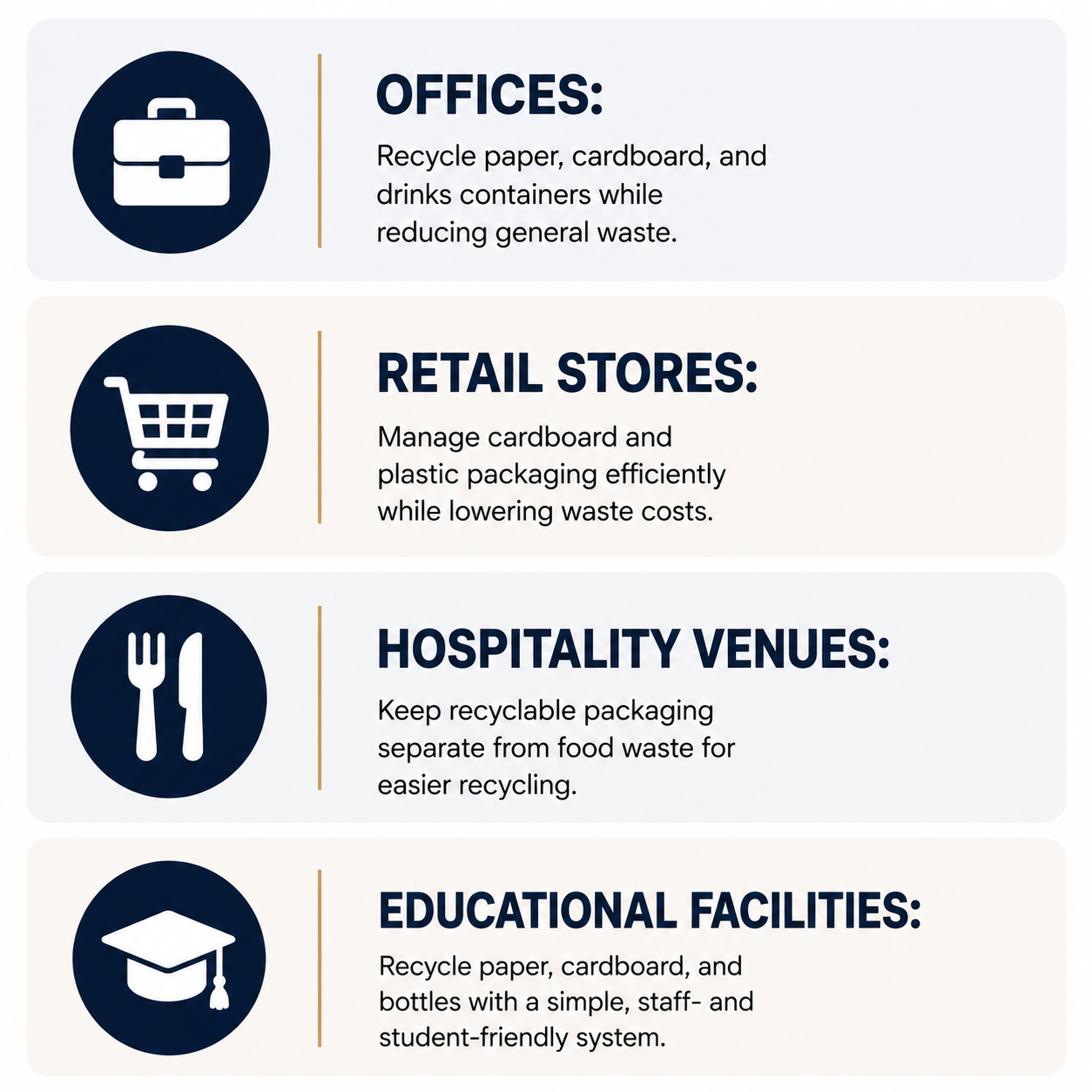
Dry mixed recycling can be implemented across a wide range of industries, but it is particularly effective for organisations that generate large volumes of paper, cardboard, plastic packaging, and drinks containers.
Offices
Office environments generate significant quantities of paper, cardboard packaging, and drinks containers. A DMR system simplifies recycling while reducing the volume of general waste produced throughout the workplace.
Retail Stores
Retail businesses regularly dispose of cardboard packaging, promotional materials, and plastic packaging. Dry mixed recycling helps streamline waste management while reducing collection costs.
Hospitality Venues
Restaurants, cafés, hotels, and leisure venues often produce a combination of recyclable packaging materials. DMR collections help separate recyclable waste from food waste streams more effectively.
Educational Facilities
Schools, colleges, and universities generate substantial quantities of paper, cardboard, and drinks containers. A simple recycling system encourages greater participation among staff and students.
Common Recycling Challenges We See Across UK Businesses
Having worked with businesses across a wide range of sectors, we regularly see the same recycling challenges appear regardless of company size.
In many workplaces, recyclable materials are still being placed in general waste bins because employees are unsure which container to use. We also frequently encounter contamination issues caused by food residue, liquids, and incorrectly disposed items such as black bin bags and batteries.
One of the most common problems is overflowing recycling bins caused by unflattened cardboard packaging. This can increase collection frequency unnecessarily and lead to avoidable waste management costs.
By implementing a clearly labelled dry mixed recycling system and providing staff with simple disposal guidelines, businesses can significantly improve recycling rates while reducing contamination.
How Enviro Waste Management Supports Businesses
At Enviro Waste Management, we support businesses across a wide range of sectors with their commercial recycling requirements. Through our daily collection operations, we regularly see how a well-managed dry mixed recycling system can increase recycling rates, reduce contamination issues, and lower general waste volumes.
Here is how we ensure your commercial recycling is handled with maximum efficiency:
• In-House Fleet and Complete Control: Unlike waste brokers who outsource your collections to unpredictable third parties, we operate our own in-house fleet of drivers. This means we control the scheduling, ensuring your dry mixed recycling is collected exactly when promised.
• Zero-Commitment Bins and Sacks: We understand that businesses have different space constraints. Whether your premises can accommodate large wheeled DMR bins or you require flexible, clear recycling sacks for kerbside collection, we provide the exact containment solution you need.
• No Guesswork with Email Alerts: You will never be left wondering when your recycling will be collected. Our automated email alerts confirm your scheduled service, and we provide a real-time ETA update on the day of collection so your facilities team always knows what is happening.
• 99.88% Landfill Diversion: We don’t just talk about sustainability; we deliver on it. Once your dry mixed recycling is collected, it is taken to advanced sorting and treatment facilities. We ensure that salvageable materials are repurposed, extending material lifecycles and currently achieving a 99.88% landfill diversion rate.
• Full Waste Reporting and Compliance: As a licensed waste carrier, we manage all of the heavy legal lifting. We provide the necessary Waste Transfer Notes to ensure your business remains perfectly compliant with UK Duty of Care regulations, taking the administrative burden off your shoulders.
Contact our specialists today to discuss your commercial bin collection requirements.
Frequently Asked Questions (FAQs)
In most cases, no.
If a load of dry mixed recycling becomes heavily contaminated by a leaking liquid or greasy food waste, the delicate paper and cardboard fibres are permanently ruined and cannot be recovered. This is why maintaining a strict “clean and dry” rule in the workplace is essential for a successful commercial recycling strategy.
Placing non-recyclable items (such as food, liquids, or black bin bags) in a DMR bin constitutes “contamination.” If a bin is highly contaminated, the sorting facility cannot process the materials safely. The waste carrier may refuse to empty the bin, or the entire load may be downgraded and sent to general waste treatment, which often incurs additional contamination charges for the business.
In a dry mixed recycling bin, yes. You can safely place clean paper, cardboard, and plastic bottles into the same container. Once the waste is collected, it is transported to a Materials Recovery Facility (MRF), where advanced sorting machinery automatically separates the paper fibres from the plastics before they are sent for recycling into new products.
Yes, you must always separate dry recyclables under Duty of Care regulations. Using a dry mixed recycling service helps. They can divert recyclable materials from general waste, improve compliance, and support sustainability objectives.
It is called “dry” because all items placed in the bin must be completely free of liquids, moisture, food residue, and grease, as wet waste can ruin the recycling process. It is called “mixed” because it allows different recyclable materials—such as paper, cardboard, rigid plastics, and metal cans—to be placed together in a single, consolidated bin.